A Reviewing Court May Reverse a Trial Courtã¢â‚¬â„¢s Judgment Only in a Case in Which the Plaintiff Lost
Chapter ii The Criminal Justice Arrangement Continuum
Section 1, Federal and State Jurisdiction
An understanding of the function and functions of the various court systems in the United States provides victim service providers with a solid foundation for understanding the dynamics of the police. The U.S. judicial system can be confusing and frustrating to victims when they are first exposed to it. Knowing some of the rationale for its present twenty-four hours limerick may assist victims empathise the foundations of our judicial system and the manner in which laws operate and interact.
Upon completion of this section, students will empathize the following concepts:
- The principle of federalism and how it affected the construction of our court system.
- How the dual arrangement of country and federal courts functions.
- The characteristics of American court systems.
- How the juvenile courtroom system functions.
- During each fiscal year, 1996 and 1997, U.S. district courts terminated an boilerplate of 296,000 cases. Approximately 84% of these cases were civil, and 16% were criminal cases (BJS 1999).
- Of the near 500,000 federal civil cases terminated during fiscal years 1996-97, 19% (96,284) were tort claims in which plaintiffs claimed injury, loss, or damage from defendants' negligent or intentional acts (Ibid.).
- Of the estimated ane.76 million cases involving delinquency charges handled in U.S. courts with juvenile jurisdiction in 1996, 53% were processed formally, either past filing a malversation petition in the juvenile court or waiving the example to criminal court (Stahl 1999).
In club to understand the principles of federal and state court jurisdiction, it is essential to have a clear understanding of how the American judicial system functions. The following department will provide a brief overview of the judicial system in the Usa.
HISTORICAL CONTEXT: THE PRINCIPLE OF FEDERALISM
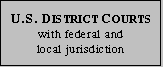
The court system in the United States is based upon the principle of federalism. The first Congress established a federal court system, and the individual states were permitted to continue their ain judicial construction. There was full general understanding among our nation's founders that individual states needed to retain significant autonomy from federal control. Under this concept of federalism, the United States developed as a loose confederation of semi-contained states having their own courts, with the federal court arrangement acting in a very express manner. In the early history of our nation, most cases were tried in state courts. It was only later that the federal government and the federal judiciary began to exercise jurisdiction over crimes and civil matters. Jurisdiction in this context simply ways the ability of the court to enforce laws and punish individuals who violate those laws.
A dual system of country and federal courts . As a upshot of this historical evolution, a dual system of state and federal courts exists today. Therefore, federal and land courts may accept concurrent jurisdiction over specific crimes. For example, a person who robs a bank may be tried and convicted in land court for robbery, then tried and convicted in federal court for the federal crime of robbery of a federally-chartered savings institution.
Court system performs its duties with trivial or no supervision . Another feature of the American court system is that information technology performs its duties with little or no supervision. A Supreme Court Justice does non exercise supervision over lower court judges in the same way that a government supervisor or manager exercises control over his or her employees. The U.S. Supreme Court and the diverse state supreme courts exercise supervision just in the sense that they hear appellate cases from lower courts and establish sure procedures for these courts.
Specialization occurs primarily at the state and local level . A third characteristic of the U.S. court system is one of specialization that occurs primarily at the land and local level. In many states, courts of limited jurisdiction hear misdemeanor cases. Other country courts of general jurisdiction try felonies. Still other courts may be designated as juvenile courts and hear only matters involving juveniles. This process also occurs in certain civil courts that hear but family police force matters, probate matters, housing matters, or ceremonious cases involving amercement. At the federal level, at that place are courts such equally bankruptcy that hear only cases dealing with specific matters.
Geographic organization of the American court system . The fourth characteristic of the American court organisation is its geographic organization. State and federal courts are organized into geographic areas. In many jurisdictions these are chosen judicial districts and contain diverse levels of courts. For example, on the federal level, the ninth Circuit Court of Appeals has district (trial) courts that hear matters inside certain specific boundaries, and an appellate courtroom that hears all appeals from cases inside that expanse. Several studies take been conducted regarding the difference in sentences for the aforementioned type of crime in geographically distinct courts. For instance, in Iowa the average sentence for motor vehicle theft was twoscore-seven months while the average sentence for the same offense in New York was fourteen months. (Pursley 1994). This should not exist taken as a criticism; rather it may reflect dissimilar social values and attitudes within specific geographic areas.
Historically each of the thirteen original states had their own unique courtroom structure. This independence continued after the American Revolution and resulted in widespread differences among the various states, some of which still be today. Because each state adopted its own system of courts, the upshot was a poorly planned and disruptive judicial structure. As a result, there have been several reform movements whose purpose has been to streamline and modernize this organisation.
Many land courts tin be divided into three levels:
- Trial courts.
- Appellate courts.
- Supreme courts.
TRIAL COURTS
Trial courts are where criminal cases commencement and finish. The trial court conducts the unabridged serial of acts that culminate in either the accused'south release or sentencing. Country trial courts can exist further divided into courts of:
- Limited or special jurisdiction.
- Courts of general jurisdiction.
The nature and type of case determines which court will have jurisdiction.
Limited jurisdiction . Courts that only hear and decide sure limited legal bug are courts of limited jurisdiction:
- Courts of express jurisdiction hear and decide bug such as traffic tickets or set bail for criminal defendants.
- Typically, these courts hear certain types of modest civil or criminal cases.
- There are approximately 13,000 local courts in the United States.
- They are called canton, magistrate, justice or municipal courts.
- Judges in these courts may be either appointed or elected.
In many jurisdictions these are part-time positions, and the incumbent may have some other job or position in addition to serving equally a judge. Even so, merely because they handle small civil and criminal matters does not mean these courts do not perform important duties. Often, the but contact the average denizen volition have with the judicial system occurs at this level.
In improver, courts of limited jurisdiction may hear certain types of specialized matters such as:
- Probate of wills and estates.
- Divorces.
- Child custody matters.
- Landlord-tenant disputes.
- Juvenile proceedings.
These types of courts may be local courts or, depending on the state, may be courts of general jurisdiction that are designated by statute to hear and make up one's mind specific types of cases. For case, in California, a superior courtroom is considered a court of general jurisdiction; all the same, certain superior courts are designated to hear only juvenile matters, thereby becoming a court of limited jurisdiction when sitting as a juvenile court.
General jurisdiction . Courts of general jurisdiction are granted authority to hear and make up one's mind all problems that are brought before them. These are courts that normally hear all major ceremonious or criminal cases. These courts are known by a variety of names, such as:
- Superior Courts.
- Circuit Courts.
- Commune Courts.
- Courts of Mutual Pleas.
Since they are courts of general jurisdiction, they have authority over all types of cases and controversies and, unless otherwise geographically limited, may decide issues that occur anywhere within the country. Some larger jurisdictions such as Los Angeles or New York may have hundreds of courts of full general jurisdiction inside the urban center limits. It is important to be certain about the right terminology for courts in each jurisdiction. For instance, the New York Supreme Courtroom is the state's trial court and its highest courtroom is called the Superior Court. But the reverse is truthful in many jurisdictions.
Typically, these courts hear ceremonious cases involving the aforementioned types of bug that courts of express jurisdiction hear, although the amount of amercement will exist higher and may attain millions.
- These courts besides hear the well-nigh serious forms of criminal matters including death penalty cases.
Courts of general jurisdiction traditionally accept the power to order individuals to practise or refrain from doing certain acts.
- These courts may issue injunctions that prohibit performing certain acts or require individuals to perform sure functions or duties.
- This authority is derived from the equity power that resides in courts of general jurisdiction.
Equity is the concept that justice is administrated co-ordinate to fairness every bit contrasted with the strict rules of law. In early on English Common Constabulary, such split up courts of disinterestedness were known as Courts of Chancery. These early courts were non concerned with technical legal problems; rather they focused on rendering decisions or orders that were fair or equitable. In modern times, the power of these courts has been merged with courts of general jurisdiction, allowing them to rule on matters that require fairness likewise as the strict application of the law.
- The ability to issue temporary restraining orders (TROs) in spousal abuse cases comes from the equitable powers of the court.
APPELLATE JURISDICTION
Appellate jurisdiction is reserved for courts that hear appeals from both limited and general jurisdiction courts.
- These courts do not hold trials or hear evidence.
- They decide matters of law and effect formal written decisions or "opinions."
At that place are 2 classes of appellate courts:
- Intermediate, or Courts of Appeals.
- Final, or Supreme Courts.
Courts of appeals . The intermediate appellate courts are known as courts of appeals. Approximately one-half the states have designated intermediate appellate courts.
- These courts may be divided into judicial districts that hear all appeals within their district.
- They will hear and decide all bug of law that are raised on appeal in both civil and criminal cases.
- Since these courts deal strictly with legal or equitable issues, there is no jury to decide factual disputes.
- These courts accept the facts as determined by the trial courts.
- Intermediate appellate courts have the authority to reverse the decision of the lower courts, and to transport the matter back with instructions to retry the case in accordance with their stance.
- They also may uphold the conclusion of the lower courtroom.
In either situation, the party who loses the appeal at this level may file an appeal with the next college appellate court.
SUPREME COURTS
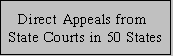
Terminal appellate courts are the highest state appellate courts. They may be known as supreme courts or courts of last resort. There may exist five, seven, or 9 justices sitting on this court depending on the land. This courtroom has jurisdiction to hear and decide issues dealing with all matters decided by lower courts, including ruling on state ramble or statutory problems. This decision is binding on all other courts within the state. Once this courtroom had decided an event, the just potential appeal left is to file in the federal court arrangement, but just if grounds for federal appellate jurisdiction exist.
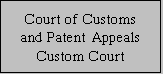
While state courts had their origin in historical custom, federal courts were created by the U.S. Constitution. Section one of Article III established the federal court system with the words providing for "i Supreme Court, and . . . such junior Courts as the Congress may from time to fourth dimension ordain and institute." From this commencement, Congress has engaged in a serial of acts that has resulted in today's federal court system. The Judiciary Act of 1789 created the U.S. Supreme Courtroom and established federal Commune Courts and Circuit Courts of Appeals.
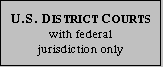
FEDERAL DISTRICT COURTS
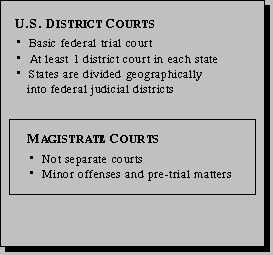
Federal District Courts are the everyman level of the federal court system. These courts have original jurisdiction over all cases involving a violation of federal statutes or other instances of statutorily-divers federal jurisdiction. These district courts handle thousands of cases per year.
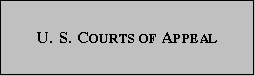
FEDERAL Circuit COURTS
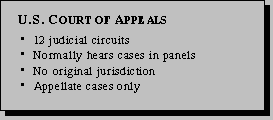
Federal Circuit Courts of Appeals are the intermediate appellate level courts within the federal system. These courts are called excursion courts because the federal system is divided into eleven circuits. A Twelfth Circuit Court of Appeals serves the Commune of Columbia area. These courts hear all appeals from U.Due south. District Courts and habeas corpus appeals from state court convictions. These appeals are usually heard by panels of iii of the appellate court judges rather than by all the judges of each circuit.
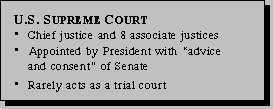
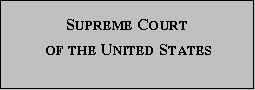
U.S. SUPREME Court
The United states Supreme Court is the highest court in the state. It has the capacity for judicial review of all lower court decisions, also as land and federal statutes. Past exercising this ability, the Supreme Court determines which laws and lower court decisions adjust to the mandates fix forth in the U.S. Constitution. The concept of judicial review was first referred to by Alexander Hamilton in the Federalist Papers, where he described the role of the Supreme Court as ensuring that the will of the people will be supreme over the volition of the legislature (The Supreme Court of the United states of america, no appointment). This concept was firmly and finally established in the U.S. judicial organisation when the Supreme Court asserted its power of judicial review in the case of Marbury v. Madison (1803).
Although it is primarily an appellate court, the Supreme Courtroom has original jurisdiction in the following cases:
- Cases betwixt the United States and a state.
- Cases between states, and cases involving foreign ambassadors, ministers, and consuls.
- Cases between a country and a citizen of another state or state.
The courtroom hears appeals from lower courts including the diverse country supreme courts. If four justices of the U.S. Supreme Courtroom vote to hear a example, the courtroom will upshot a Writ of Certiorari. This is an club to a lower court to transport the records of the case to the Supreme Courtroom for review. The courtroom meets on the get-go Monday of October and usually remains in session until June. The court may review any example information technology deems worthy only it actually hears very few of the cases filed. Of approximately 5,000 appeals each year, the court agrees to review about 200, but may not issue an opinion on each example.
VICTIM CASES AT THE SUPREME COURT LEVEL
The Supreme Court handles perhaps the broadest conceivable array of legal and social issues. Contempo victim-related Supreme Court decisions have addressed the following topics:
- Victim affect statements.
- Hate crimes.
- Child victims of criminal offense.
- Notoriety-for-turn a profit for perpetrators.
Because of the significant increase in importance of juvenile crime in our order, an overview of juvenile courts inside the state and federal court system is of import. While there are some differences, both federal and state systems were initially founded upon the concept of rehabilitation of immature offenders. Additionally, both systems wanted to shield juveniles from public scrutinies; therefore, each contained provisions for keeping juvenile matters confidential.
THE FEDERAL Court JUVENILE Arrangement
When Congress addressed the issue of juvenile offenders, information technology established two alternatives for the prosecution of juveniles:
- The juvenile can waive his or her rights to be treated as a juvenile.
- The juvenile can accept the affair treated every bit a ceremonious proceeding called juvenile adjudication.
If the court finds that the juvenile committed the offense, he or she faces a series of federal sanctions including detention. There is a federal preference for country prosecution of juveniles since there is no dissever federal juvenile courtroom estimate or juvenile detention system. If a juvenile is adjudicated to be a delinquent, he or she is placed in a state juvenile facility or on juvenile probation. The federal authorities contracts with states for this service.
Until the passage of the Crime Control Act of 1990, the federal authorities only prosecuted juveniles who committed crimes on federal reservations, where united states had no jurisdiction. The Crime Control Human action added two other categories of juveniles who fall under federal juvenile court jurisdiction: juveniles who commit felony crimes of violence and/or those juveniles involved in certain drug felonies. Like to most state court systems, federal police allows for the transfer or certification of a juvenile to "adult status." This procedure allows juveniles to be tried every bit adults in either the land or federal court system.
Nether federal constabulary, juveniles are those persons nether twenty-one who commit a federal offense before their eighteenth birthday. A federal judge acts as the federal equivalent of the state juvenile court gauge. The proceedings are typically confidential with no members of the news media in attendance. Federal jurisdiction in juvenile matters is established where:
- The state does non have jurisdiction.
- The land does not have programs or services available for juveniles.
- The crime charged is a violent felony or drug crime and there is a substantial federal interest in the case.
A juvenile proceeding is initiated past the filing of an information. In most cases, the U.S. Attorney must file a certification stating that there are grounds for federal jurisdiction. The hearing in federal court is very similar to a court trial.
THE State Court JUVENILE Organisation
The carve up handling of juvenile justice matters has roots throughout history. Even in before periods in America, sure specific juvenile accommodations were in employ. Still, the present mean solar day American state-level juvenile courtroom organisation dates back to 1899 when the state of Illinois passed the Illinois Juvenile Court Act. It was at that time that the juvenile court organization as we know information technology today came into existence (Flim-flam 1972). This statute separated the juvenile court system from the developed criminal arrangement. It labeled minors who violated the police as "delinquents" rather than criminals, and required that juvenile court judges determine what "is in the best interests of the minor" in rendering their decision.
The juvenile court system is guided by five bones principles:
1. The country is the ultimate parent of all children within its jurisdiction (the doctrine of parens patriae) and has the power to step into the parental role in loco parentis.
2. Children are worth saving and the state should use non-punitive measures to do so.
three. Children should be nurtured and not stigmatized past the court procedure.
4. Each child is dissimilar and justice should exist tailored to meet private needs and requirements.
5. The apply of noncriminal sanctions are necessary to give principal consideration to the needs of the kid (Cadwell 1966, 358).
It is important to note that each state determines its own jurisdictional age of "minors" handled by its juvenile organisation. Most involve children who are under eighteen years of age. A few states employ higher ages, up to xx-one, commonly for specific issues. In response to increasingly tearing juvenile crime, some states have lowered their upper age limit for juvenile jurisdiction to fifteen, and even fourteen years of historic period.
While these principles were originally adopted for delinquents or minors who committed criminal acts, they accept been broadly applied to proceedings involving children who are victims of corruption. Juvenile courts have jurisdiction over 3 types of minors:
- Delinquents.
- Status offenders.
- Dependent children.
Delinquents are minors who take committed criminal offenses. Condition offenders engage in acts that are non problematic if committed by an adult, such as truancy, running away from home, or incorrigible behavior. Dependent children are those who are in need of state intervention because of corruption or fail by their caretakers.
ABUSE AND NEGLECT PROCEEDINGS
While the procedure is basically the same for delinquents also as dependent minors, the juvenile court process dealing with children who are victims of corruption or fail is of particular importance to victim service providers:
- This process is usually initiated by filing a petition with the court.
- A petition is a formal pleading that alleges that the parents or custodians endangered the wellness or welfare of the kid.
- The petition may allege neglect, concrete, emotional or sexual abuse of the child and gives the juvenile court say-so to act.
Detention hearings in kid maltreatment . Once the petition is filed, many jurisdictions concur a show cause or detention hearing. This hearing is usually conducted within twenty-four to forty-eight hours later filing the petition or the emergency removal of the kid. The detention hearing requires child protective services or police to produce bear witness justifying the emergency removal of the child, or to present prove that would allow the courtroom to order the removal of the child if he or she is still in the custody of the parents. The parents may as well admit or deny the allegations contained in the petition at this hearing.
- If they admit the allegations, the court orders child protective services to conduct an investigation to make up one's mind where the child should exist placed as a result of the admissions past the parents.
- If the parents deny the allegations, the court sets a date for an adjudicatory or jurisdictional hearing.
Pending this hearing, the court may order the child temporarily placed in a living organisation exterior the home.
Child abuse and neglect adjudicatory or jurisdictional hearing . An adjudicatory or jurisdictional hearing is used to determine if in that location is sufficient testify to determine whether the allegations in the petition are truthful. At the conclusion of this hearing, the court will render its decision. If the petition is upheld, the court sets a appointment for a dispositional hearing. If the petition is non upheld, the child is returned to the parents and the example is dismissed.
- During the adjudicatory hearing, the state presents bear witness to support its claim that the kid has been driveling.
- This may have the grade of having the child testify to the incident, or experts employed by the state may render their opinion regarding the facts surrounding the case.
- The state is represented past a juvenile prosecutor, state's advocate, county counsel or other governmental attorney.
- The parents accept a right to cantankerous examine witnesses and present any show they want in rebuttal to the state's evidence.
- At the terminate of the hearing, both parties may present arguments in favor of their position.
The burden of proof to uphold the abuse or neglect petition is the same every bit a civil example. In civil trials, the plaintiff has the burden of proving the case past a preponderance of the evidence. This is usually defined as slightly more than l per centum. A criminal example requires proof beyond a reasonable doubt. This is not proof beyond all uncertainty, simply it is proof of the "cloth facts to a moral certainty" that they did occur.
- In juvenile dependency cases, in order to remove the child from the custody of his or her parents, some jurisdictions require proof by clear and disarming bear witness. This is more than a preponderance of the show, but less than beyond a reasonable incertitude (Otterson 1979).
Once the adjudicatory or jurisdictional hearing is ended, the next hearing to occur is the dispositional hearing. This hearing is to determine where the child should be placed. The court will determine whether the kid should be immediately returned to his or her parents or placed in an out of home environment for a period of time. The guiding principle in this hearing is "the best interests of the child." If the courtroom orders the child placed outside the home, it may schedule periodic reviews to determine if or when the child will be reunited with the parents. Typically, a specific plan regarding placement is established and monitored.
From the beginning of the intervention process until the final dispositional hearing and beyond, every party in the activity has certain rights. The parents and the child each has distinct rights that must be observed and protected. These rights include:
- Notice.
- An opportunity to be heard and present show.
- The right to face up and cross-examine witnesses.
- Effective representation past an attorney.
In a dependency hearing, the rights of a child include appointing an attorney who volition speak on behalf of the child. This attorney must represent what he or she believes is in the best interests of the child regardless of what CPS or the parents' advocate believes is advisable. In some jurisdictions this is a authorities-funded attorney; in others, it is a private attorney appointed by the courtroom to stand for the kid. Depending on the case, the attorney may side with the parents and argue for render of the child to their intendance, or the attorney may take the position that it is in the best interests of the kid to be removed from the custody of the parents. Even if the child is removed temporarily from the custody of his or her parents, the child has a right to reunification efforts after a reasonable time.
Many jurisdictions additionally engage Court Appointed Special Advocates (CASAs), or similarly trained (typically non-attorney) individuals. The office of these child advocates is to present to the court an independent analysis of what is best for the child. This is peculiarly of import; as the child's legal representative, the courtroom-appointed lawyer must forward the child's wishes when an objective view would be to the contrary. For example, the lawyer may decide that he or she must vigorously advocate a juvenile's wish to return dwelling house, while an independent child abet may decide that this is not actually in the kid'southward all-time interest.
During dependency hearings, parents have a correct to notice of the hearing, an opportunity to be present at that hearing and to be represented by an attorney. They may nowadays whatever evidence they desire to rebut the charges. If the child is removed from their custody, they have the right in most jurisdictions to a re-unification plan that will allow them to regain custody of the kid once they have finished treatment or counseling or complied with other courtroom orders.
VICTIMS' RIGHTS IN JUVENILE DELINQUENCY MATTERS
Among the most apace changing areas in the victim assistance field is the extension of victim rights in juvenile malversation proceedings. Historically, juvenile courts have been closed proceedings and records take been generally confidential. Even the victim was unable to larn much, if anything, about the progress of a example against the juvenile who allegedly offended confronting them. Juvenile delinquency proceedings are analogous, in many ways, to adult criminal trials, with all the typical obstacles to victim participation. The juvenile courtroom's confidentiality provisions for alleged delinquents exacerbate these obstacles tremendously.
Many states have, or are, considering rolling dorsum their previously difficult and fast confidentiality statutes. States like Connecticut, Missouri, and Arizona have gone farther to provide for victims' rights and accommodations in juvenile courts that mirror those in developed courts. This provides fertile footing for expansion of victim advancement and aid efforts to a previously underserved population, victims of juvenile law-breaking.
Adjudicatory or Jurisdictional Hearing: Used to determine if there is sufficient evidence to find the allegations in the petition are true.
Delinquents: Those minors who have committed criminal offenses.
Status Offenders: Minors who are truant from schoolhouse, run away from dwelling house or are considered incorrigible.
Dependent Children: Those who are in demand of country intervention because of neglect or abuse by their caretakers.
Detention Hearing: Requires child protective services or constabulary to produce prove justifying the emergency removal of the child or nowadays prove that would permit the courtroom to order the removal of the kid if he or she is however in the custody of the parents.
Dispositional Hearing: To make up one's mind where the child should exist placed.
Parens Patriae: Meaning "the land is the parent," this doctrine is fundamental to the juvenile court'southward ability to decide on placements, treatment and other determinations regarding children.
Petition: A formal pleading that alleges that the parents or custodians endangered the health or welfare of the child.
Writ of Certiorari: An club to a lower court to send the records of the example to the Supreme Court for review.
FEDERAL COURTS
STATE COURTS





Federal and State Jurisdiction Self-Examination
1. Depict how the federal and state courts function.
2. Draw the differences between courts of limited jurisdiction and courts of general jurisdiction.
three. What are the principles upon which the juvenile justice system was founded?
4. Describe the cases over which the U.S. Supreme Courtroom has original jurisdiction.
Dorsum to NVAA
| 2000 NVAA Text | Chapter 2.ane |
Source: https://www.ncjrs.gov/ovc_archives/academy/chap2-1.htm
0 Response to "A Reviewing Court May Reverse a Trial Courtã¢â‚¬â„¢s Judgment Only in a Case in Which the Plaintiff Lost"
Post a Comment